Tulip Poplar: Maryland\'s Tallest Native Tree
Tulip Poplar is the tallest native tree in the eastern United States and one of the most distinctive trees in Maryland\'s forests. Here\'s how to identify it and what makes it so special.

If you've spent any time in Maryland's forests, you've almost certainly walked under a Tulip Poplar without knowing it. These trees are everywhere — and they're enormous.
Liriodendron tulipifera, the Tulip Poplar (also called Tulip Tree or Yellow Poplar), is the tallest native tree in the eastern United States. In good conditions, it regularly reaches 100 to 150 feet, with some old-growth specimens exceeding 190 feet. The trunk is straight, tall, and clean — it looks almost architectural in a mature forest.
Despite the name, Tulip Poplar is not actually a poplar. It's a member of the Magnolia family (Magnoliaceae), and it's the only species in its genus native to North America.
How to Identify Tulip Poplar
The leaves are the easiest field mark — once you know them, you'll never mistake this tree for anything else.
Leaves: The leaves are large (4 to 8 inches wide), with a distinctive shape that looks like a tulip or a cat's face — four lobes with a flat or slightly notched tip. No other common tree in Maryland has this leaf shape. They turn a clear, bright yellow in fall.
Flowers: The flowers are spectacular — tulip-shaped, 2 to 3 inches across, with yellow-green petals and an orange band at the base. They bloom in May and June, but because they appear high in the canopy, most people never notice them. If you find a flower on the ground in late spring, look up — there's a Tulip Poplar above you.
Bark: On young trees, the bark is smooth and gray-green. On mature trees, it becomes deeply furrowed with interlacing ridges — a distinctive pattern that's easy to recognize once you've seen it a few times.
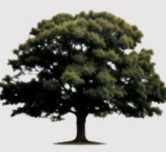
Form: Tulip Poplars have a very straight, tall trunk with a relatively narrow crown compared to their height. In a forest, they often tower above the surrounding canopy.
Fruit: The fruit is a cone-like aggregate of winged seeds (samaras) that persists on the tree through winter. The dried brown cones are easy to spot on bare branches.
Where Tulip Poplar Grows in Maryland
Tulip Poplar is found throughout Maryland in moist, well-drained soils — forest slopes, coves, and bottomlands. It's one of the most common trees in the Piedmont and is abundant in the coastal plain as well. It grows fast (2 to 3 feet per year in good conditions) and is often one of the dominant trees in second-growth forests.
It's also widely planted as a landscape tree, though its size means it needs plenty of space.
Tulip Poplar and Wildlife
The flowers produce large quantities of nectar and are heavily visited by bees, hummingbirds, and other pollinators. The seeds are eaten by finches, cardinals, and small mammals. The tree is a host plant for the Eastern Tiger Swallowtail butterfly — one of the most beautiful butterflies in Maryland — whose caterpillars feed on the leaves.
Tulip Poplar and People
Tulip Poplar has been economically important in the eastern United States for centuries. The wood is lightweight, straight-grained, and easy to work — it was widely used for furniture, cabinetry, and interior trim. Native Americans used the large trunks to make dugout canoes.
Today, Tulip Poplar lumber (sold as "Yellow Poplar" in the trade) is still used for furniture, millwork, and plywood.
Tree Care Considerations
Tulip Poplars are generally healthy trees, but there are a few things to watch for:
- Aphids can cause heavy honeydew drip in summer — annoying but rarely harmful to the tree
- Tulip Poplar scale is an occasional pest
- Root damage from construction or soil compaction can cause decline in urban trees
- Storm damage — the tall, straight form means these trees can be vulnerable to wind and ice loading, especially if they've lost lower branches
Large Tulip Poplars near homes deserve periodic inspection by a certified arborist, especially after significant storms.
A Tree Worth Knowing
Tulip Poplar is one of those trees that, once you learn to identify it, you start seeing everywhere. The distinctive leaf shape, the tall straight form, the spectacular spring flowers — it's a tree with a lot of personality.
Next time you're in a Maryland forest, look up. If the canopy seems impossibly high, you're probably standing under a Tulip Poplar.
Have a large Tulip Poplar near your home? Arundel Tree Service provides professional tree assessment and care across Anne Arundel County and surrounding Maryland communities.
Explore Topics
Written by
Arundel Tree Service
Content creator and writer sharing insights and stories.


