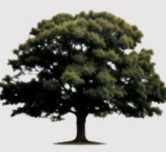
Shagbark Hickory: The Tree You Can Identify from 50 Feet Away
Shagbark Hickory has one of the most distinctive barks of any tree in Maryland — long, shaggy plates that curl away from the trunk like peeling paint. Here\'s how to find and identify it.

Some trees require careful study — you need to examine the leaves, check the bark, look at the buds. Shagbark Hickory is not one of those trees.
Carya ovata has one of the most distinctive barks of any tree in the eastern United States. Long, thick, gray plates curl away from the trunk at both ends, giving the tree a shaggy, almost disheveled appearance that's visible from a considerable distance. Once you've seen it, you'll never mistake it for anything else.
The Bark: Your Best Field Mark
The bark of mature Shagbark Hickory is the defining feature. The plates are typically 1 to 3 feet long, attached in the middle, and curling away from the trunk at both ends. The effect is dramatic — the tree looks like it's perpetually in the process of shedding its skin.
Young Shagbark Hickories (under about 10 inches in diameter) have smoother, more tightly ridged bark that hasn't yet developed the full shaggy character. But by the time the tree reaches a foot in diameter, the shaggy plates are usually well established.
Other Identification Features
Leaves: The leaves are pinnately compound — a central stalk with 5 leaflets (occasionally 7), each 4 to 6 inches long. The leaflets are oval with finely toothed margins. The terminal leaflet is noticeably larger than the others. The leaves turn a rich golden yellow in fall.
Nuts: The nuts are enclosed in a thick, four-sectioned husk that splits open at maturity. The nut itself is round to slightly elongated, with a sweet, edible kernel. Shagbark Hickory nuts are considered the best-tasting of all the hickories — rich, buttery, and sweet. They were an important food source for Indigenous peoples and early settlers.
Buds: The winter buds are large and distinctive — covered in overlapping scales that give them a somewhat layered appearance. The terminal bud can be 3/4 inch long.
Form: Shagbark Hickory is a tall, straight tree, typically 60 to 80 feet at maturity, with a narrow, somewhat irregular crown.
Where Shagbark Hickory Grows in Maryland
Shagbark Hickory is found throughout Maryland in upland forests, particularly on well-drained slopes and ridges. It's common in the Piedmont and less common in the coastal plain. It often grows alongside White Oak, Red Oak, and Tulip Poplar in mixed hardwood forests.
It prefers deep, fertile, well-drained soils and doesn't tolerate prolonged flooding or heavy clay.
Wildlife Value
Shagbark Hickory is one of the most important mast-producing trees in the eastern United States. The nuts are eaten by squirrels, chipmunks, white-tailed deer, black bears, wild turkeys, and wood ducks. Squirrels cache large quantities of hickory nuts in fall, and the ones they forget contribute to forest regeneration.
The shaggy bark creates excellent habitat for bats, which roost under the loose plates. Several species of native bats, including the Little Brown Bat and the Eastern Small-footed Bat, are known to use Shagbark Hickory as a roosting site.
The Nuts: Worth Harvesting
If you have Shagbark Hickories on your property, the nuts are worth collecting. They're labor-intensive to crack — the shell is thick and hard — but the flavor is excellent. They can be used anywhere you'd use pecans (which are also in the Carya genus).
The best time to collect is right after they fall in October and November, before the squirrels get them all.
Shagbark vs. Other Hickories
Maryland has several hickory species, and they can be tricky to distinguish:
- Shagbark Hickory (C. ovata) — shaggy bark, 5 leaflets, sweet nuts
- Mockernut Hickory (C. tomentosa) — rough but not shaggy bark, 7–9 leaflets, thick-husked nuts
- Pignut Hickory (C. glabra) — smooth to slightly ridged bark, 5 leaflets, bitter nuts
- Bitternut Hickory (C. cordiformis) — yellow buds, 7–11 leaflets, very bitter nuts
The shaggy bark makes Shagbark Hickory the easiest of the group to identify.
A Tree Worth Protecting
Shagbark Hickory is slow-growing and long-lived — trees can reach 200 years or more. If you have one on your property, it's a genuine asset. The nuts feed wildlife, the bark provides bat habitat, and the wood is among the hardest and strongest of any North American tree (hickory wood is used for tool handles, drumsticks, and smoking meat).
Have hickory trees on your Maryland property? Arundel Tree Service can assess their health and provide professional care. We serve Anne Arundel County and surrounding communities.
Explore Topics
Written by
Arundel Tree Service
Content creator and writer sharing insights and stories.


